Artificial Intelligence and Microchips Define the Future of Lost Pet Recovery
March 23, 2026
“AI systems now help identify and locate lost pets by matching photos across shelter, social media, and community networks, while microchips provide permanent ID that lets a finder confirm and reunite a pet with its owner.”
Estimated Reading Time: 13~14 min┃Post by Dr. Lila Mercer
For decades, the heartbreak of a missing pet has followed a familiar script: printed flyers taped to lampposts, frantic neighborhood searches, and hopeful calls to local shelters. While these methods still exist, a technological shift is rapidly redefining how pets are found—and how quickly they return home. Artificial intelligence is emerging as a powerful force in pet recovery, fundamentally changing the odds for millions of lost animals each year.
The scale of the problem is enormous. In the United States alone, millions of pets go missing annually, with estimates reaching around 10 million cases each year. Historically, the chances of reunion have varied widely depending on identification methods, local resources, and sheer luck. Today, AI is reshaping those probabilities through automation, pattern recognition, and massive data aggregation.
The Rise of AI in Pet Recovery
At the center of this transformation is AI-powered visual recognition. Platforms such as Petco Love Lost and similar systems rely on machine learning algorithms trained to identify animals based on their unique physical characteristics. These systems analyze features like fur patterns, facial structure, ear shape, and even subtle distinctions such as markings around the eyes or nose. Unlike human observation, which can be inconsistent and limited by memory, AI systems can process thousands—sometimes millions—of images in seconds.
The process is deceptively simple from the user’s perspective. A pet owner uploads a photo of their missing dog or cat. The system then compares that image against a continuously updated database sourced from shelters, rescue organizations, social media posts, and even doorbell camera footage. When a potential match is identified, the owner is alerted, often within hours or days rather than weeks.

Another crucial advantage of AI is its ability to compensate for changes in a pet’s appearance. Lost animals often become dirty, lose weight, or grow thicker coats over time, making them difficult to recognize. AI systems, however, are trained to detect invariant features—structural traits that persist despite environmental changes. This allows them to identify pets even when they look significantly different from their original photos.
Beyond individual matches, AI is also enhancing collaboration across fragmented systems. Traditionally, shelters, veterinary clinics, and local communities operated in silos. AI platforms unify these networks by aggregating data into centralized or interconnected systems, effectively creating a nationwide—or even global—search infrastructure. This interconnectedness dramatically increases the probability of a successful match.
Emerging technologies are pushing these capabilities even further. Some systems now integrate predictive analytics, estimating where a lost pet might travel based on behavior patterns and environmental factors. Others combine AI with community-based tools, such as smart doorbell networks that scan neighborhoods for missing animals. The result is a layered ecosystem where detection, identification, and notification happen almost simultaneously.
Despite these advances, AI is not a standalone solution. It operates most effectively when integrated into a broader recovery strategy—one that includes traditional identification methods, community engagement, and responsible pet ownership. This raises an important question: if AI is becoming so effective, what role do older technologies like microchips still play?
Microchips: The Proven Backbone of Pet Identification
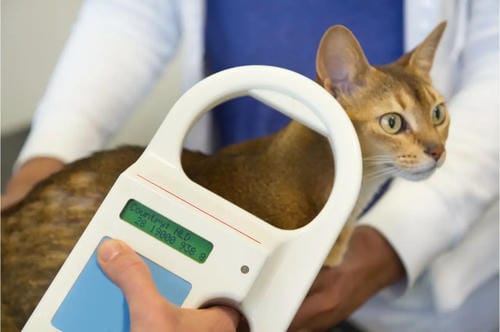
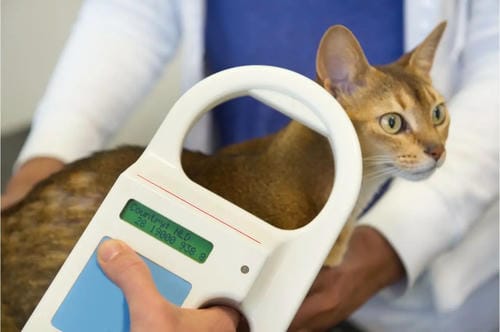
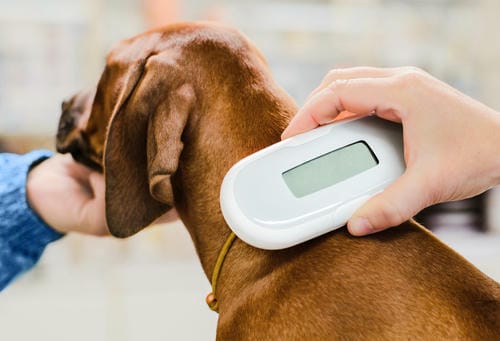
Long before AI entered the scene, microchips established themselves as the gold standard for pet identification. These tiny devices, roughly the size of a grain of rice, are implanted beneath a pet’s skin and contain a unique identification number that can be read by a scanner. Unlike collars or tags, which can be lost or removed, microchips provide a permanent and tamper-resistant form of identification.

The effectiveness of microchips is well documented. Studies show that pets with microchips are significantly more likely to be reunited with their owners than those without. For example, more than half of lost dogs with microchips are returned home, compared to a much lower percentage of unchipped animals. This disparity highlights the critical role microchips have played in improving recovery outcomes over the past few decades.
Microchips offer several advantages that AI alone cannot replicate. First, they provide definitive proof of ownership. In situations involving disputes—such as theft or custody disagreements—the unique ID stored in a microchip can serve as legal evidence. Second, microchips are independent of external systems like internet connectivity or image databases. As long as a scanner is available, the chip can be read.
However, microchips are not without limitations. One of the most significant constraints is that they are passive devices. They do not track a pet’s location in real time and require the animal to be physically found and scanned. This means that if a lost pet is not brought to a shelter or veterinary clinic, the microchip cannot assist in the recovery process.
Another challenge lies in data management. A microchip only stores an identification number; the owner’s contact information must be linked to that number in a database. If the registration is incomplete or outdated, the chip becomes far less effective. In some cases, database failures or company shutdowns have even disrupted access to this critical information, leaving pets temporarily untraceable.
Additionally, microchips depend heavily on human intervention. A shelter worker or veterinarian must take the initiative to scan the animal and then follow up using the associated registry. This introduces delays and variability, especially in regions with limited resources or inconsistent practices.
These limitations have prompted some experts to argue that microchips, while essential, are no longer sufficient on their own. As technology evolves, the expectation is shifting toward more proactive and dynamic solutions—systems that can locate pets before they even reach a shelter.
Will AI Replace Microchips—or Reinforce Them?
The rapid success of AI in pet recovery naturally leads to speculation about whether it could eventually replace microchips altogether. On the surface, AI appears to offer a more advanced and efficient solution. It is faster, more scalable, and capable of operating across vast digital ecosystems without requiring physical interaction with the animal.
However, this perspective overlooks a fundamental distinction between identification and detection. AI excels at detection—finding and recognizing pets in images and videos across distributed networks. Microchips, on the other hand, excel at identification—providing a definitive, verifiable link between a pet and its owner.
These functions are complementary rather than interchangeable. AI can locate a pet, but it cannot independently verify ownership with the same level of certainty as a microchip. Conversely, a microchip can confirm identity, but it cannot help locate a pet that has not yet been found.
In practice, the most effective approach combines both technologies. AI can dramatically shorten the search phase by identifying potential matches quickly, while microchips ensure that once a pet is found, the reunion process is accurate and secure. This dual-layer system addresses both speed and reliability, two critical factors in successful recoveries.
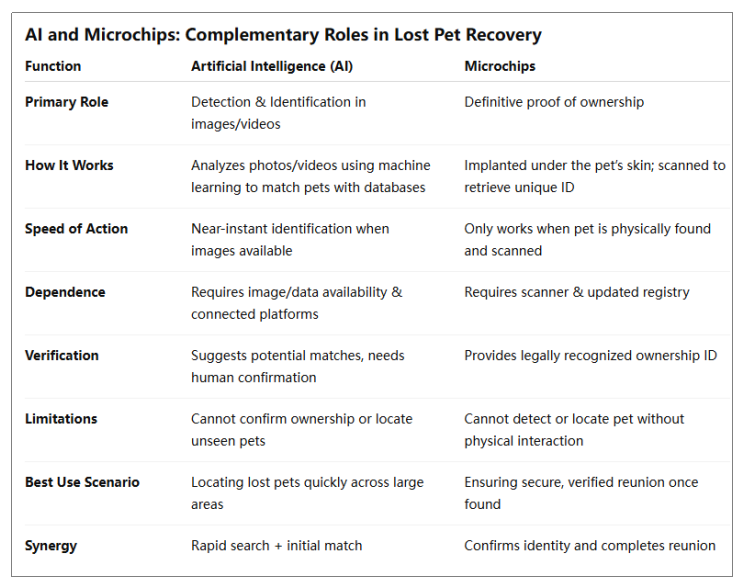
There are also practical considerations that limit AI’s ability to fully replace microchips. AI systems depend on the availability and quality of images. If a pet has never been photographed clearly, or if no images are available in the system, the technology cannot function effectively. Microchips, by contrast, do not rely on visual data and remain functional regardless of external conditions.
Veterinarians, shelters, and animal welfare organizations increasingly advocate for a layered approach: microchipping as a baseline, supplemented by AI platforms and additional tracking technologies. This strategy reflects a broader trend in technology adoption, where redundancy and interoperability enhance overall system resilience.
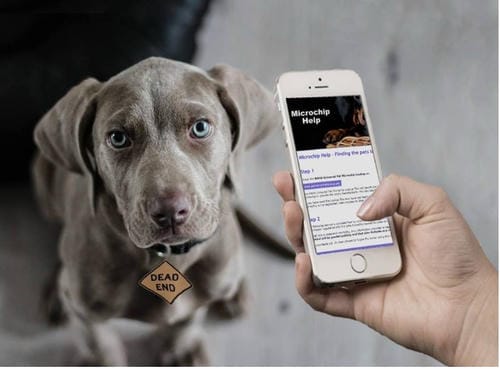
As AI continues to evolve, its role in pet recovery will almost certainly expand. Algorithms will become more accurate, databases more comprehensive, and networks more interconnected. Yet the enduring value of microchips suggests that the future is not about choosing one technology over another. It is about leveraging the strengths of each to create a system where fewer pets are lost—and more find their way home faster than ever before.
About the Author
Dr. Lila Mercer. She is a veterinary technology consultant and former animal shelter operations director with over 15 years of experience in companion animal welfare. She has led digital transformation initiatives for multi-state rescue networks, specializing in pet identification systems, data integration, and emerging AI applications in animal services. Dr. Mercer holds a DVM and a master’s degree in Information Systems, and her work has been featured in veterinary journals and animal welfare policy forums.
References
[1] Palmer, S. (2025). AI for good: The technology helping thousands of lost pets every week.
[2] Kalla, N. S. (2026). Microchips on pets: The lifesaver that helps lost dogs and cats find their way home.
[3] The Washington Post. (2026). These people used AI to help find their lost pets.
[4] Michigan’s Thumb. (2025). Save This Life microchip shutdown leaves pet owners seeking answers.
Keep browsing! Our blog is full of pet advice, heartwarming stories, and useful guides!