How Pets Are Communicating with Button Technology?
March 23, 2026
In this Article:
● Some pet owners use soundboard buttons that play recorded words when pressed to help animals communicate their needs.
● Studies show dogs trained with these buttons can respond appropriately to specific words like “play” or “outside,” suggesting word comprehension.
● Research indicates dogs may press buttons in non‑random patterns and combine two buttons in ways that reflect their desires or requests.
Estimated Reading Time: 12–15 min
Post by Alex Greenwood
Imagine walking into your living room and hearing your dog press a button that says “outside” or watching your cat tap a button that says “treat” to let you know it’s snack time. What once lived only on social media as viral videos and cute clips has transformed into a widespread phenomenon among pet owners seeking to better understand their animal companions. Button-based communication—the practice of teaching pets to press buttons pre-recorded with human words or phrases—is capturing the imagination of pet lovers around the world and raising fascinating questions about animal cognition, connection, and the future of interspecies communication.
What Button-Based Communication Is and Why Pet Lovers Are Buzzing?
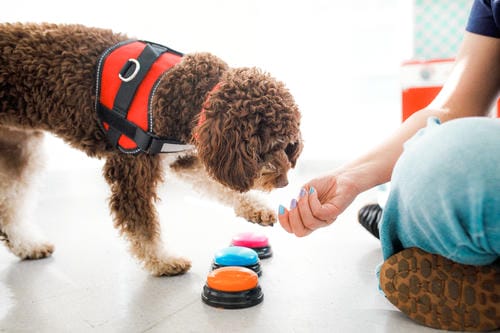
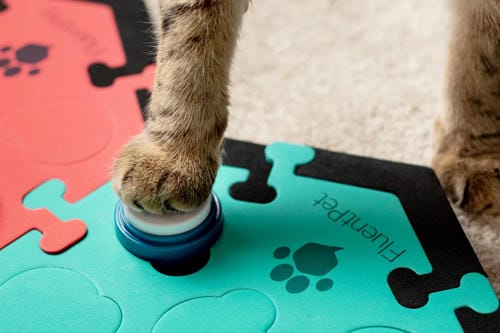
Button systems, sometimes referred to as soundboards or Augmentative and Alternative Communication (AAC) devices adapted for animals, are relatively simple tools. Each button is programmed by the pet owner to play a specific word or phrase when pressed. For example, pressing a button labeled “walk” triggers the recorded sound of that word. Through consistent training, many pets begin to associate the button’s sound with its corresponding activity, object, or concept. Early adopters of this method have used grids of hexagon buttons, color-coded arrays, or customized mats to help their animals navigate through vocabulary sets. What makes this particularly compelling for pet owners is not just the novelty of sound coming from a pet, but the seeming intentionality behind some of the presses—especially when a dog or cat presses the button in context and at the right time.
Over the past few years, viral stories and widely shared videos have stoked public fascination. Dogs and cats are featured pressing buttons for food, play, love you, and beyond. Some pet owners claim their animals even string together two-button combinations, like “want” + “outside,” which appears conversational or expressive. These reports invite us to reflect on the long-standing desire to bridge the communication gap between humans and other species—an aspiration as old as pet keeping itself.
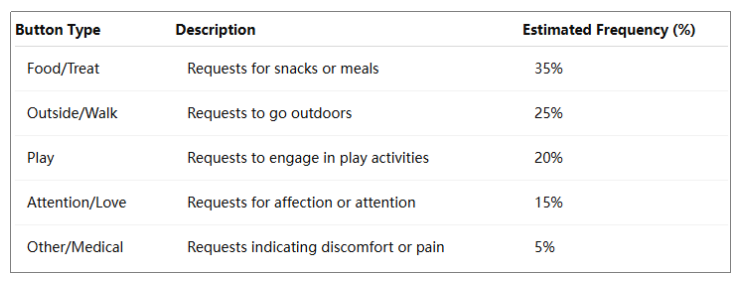
(Chart: Frequency of Button Presses by Type of Request)
Visual Note: This chart reflects patterns observed in research (like the 150-dog dataset) and anecdotal reports described in the article. It can be used to highlight which communications are most common among pet users of button technology.
Yet behind the heartwarming anecdotes lies a crucial distinction that scientists make clear: button press behavior is not automatically equivalent to human-style language or syntax. Animal communication systems are fundamentally different from human language, which involves complex grammar and abstract concepts. Most researchers agree that pet use of buttons, at least at this stage, reflects learned associations and conditioned responses tied to outcomes and context rather than a deep understanding of human semantic categories. In other words, pressing “treat” may reliably communicate a desire for a snack, but it doesn’t necessarily mean the animal is forming sentences the way people do.
What Science Says: From Anecdotes to Rigorous Research
While button-based communication has been popularized on the internet and embraced by many pet owners, it has also inspired rigorous scientific inquiry. Rather than dismissing the phenomenon as mere tricks or conditioned behavior, researchers are increasingly intrigued by what these interactions can reveal about animal cognition, learning, and the ways pets understand human signals.
One of the most notable research efforts is an ongoing longitudinal project led by Dr. Federico Rossano at the Comparative Cognition Lab at the University of California, San Diego. This large-scale investigation is focused specifically on Augmentative Interspecies Communication (AIC) using buttons, and it involves both controlled experimental conditions and extensive owner-reported data. Rather than simply watching viral videos, scientists are applying systematic scientific methodology to determine whether dogs truly comprehend specific words produced by buttons and whether their button presses reflect intentional communication beyond cueing or random behavior.

In the summer of 2024, a study published in PLOS ONE presented compelling initial results from this project. The research revealed that dogs trained with soundboard buttons were not only able to recognize specific words but also respond in contextually appropriate ways. Importantly, dogs responded to button word sounds even when an unfamiliar person pressed the button or when the owner’s body language and cues were minimized, suggesting that the animals were reacting to the words themselves, not just subtle human prompts or environmental gestures. These findings point toward more than simple conditioned responses, indicating some level of true word comprehension.
Another research output published in Scientific Reports examined thousands of button presses collected from over 150 dogs over an extended period. This analysis showed that dogs use non-accidental and non-random combinations of two buttons more often than would be expected by chance. While still cautious about attributing language to these behaviors, researchers interpret this as evidence that dogs are not merely mimicking their owners; instead, they are selecting buttons in ways that reflect predictable patterns associated with their needs or desires.
Despite these advances, scientists emphasize caution about overinterpretation. Human language involves abstract concepts, syntax, and generative grammar—complex cognitive architectures that are not yet evidenced in pet button communication. Evidence so far supports that dogs can associate words with outcomes and use buttons purposefully to request or indicate things, but whether they possess the deeper cognitive structures of language remains an open question.
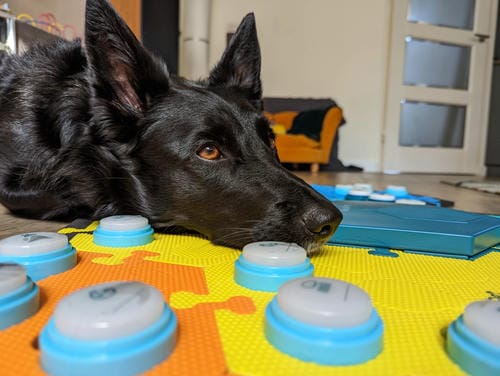
Further research may refine our understanding of how pets represent concepts internally, and what limits exist in their communicative capacities.
At the same time, the popularity of button communications has helped legitimize the scientific study of interspecies communication, positioning it not merely as a quirky trend but as a vehicle for deeper understanding of animal minds. Institutions involved in this research are actively inviting dog and cat owners to participate in studies and contribute data to improve scientific insights into how and why animals use buttons to communicate.
What the Buttons Means for the Human–Animal Bond?
The rise of button-based communication is reshaping how many pet owners think about the emotional and cognitive lives of their animals. Even as scientists distinguish between associative learning and true linguistic competence, the practical, emotional, and bonding benefits of buttons are difficult to deny. Pets trained with buttons often seem more engaged with their owners, and owners report that these communication systems help them better understand subtle needs and internal states of their pets. Seeing a dog press “play” when it wants to chase a ball or a cat press “love” when it seeks attention feels, for many households, like a breakthrough in connection.
Button systems may also hold promise for improving welfare, particularly for animals that have difficulty expressing discomfort or medical issues. A pet who can reliably indicate “pain” or “hurt” via a button, for instance, could help owners recognize health problems earlier and seek veterinary care before a condition worsens. This has practical implications for animal wellbeing, especially among older pets or those with chronic conditions.
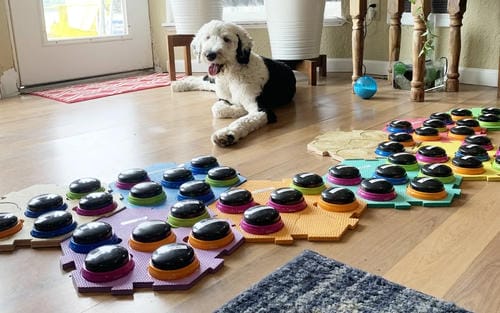
Importantly, button communication also invites us to rethink our assumptions about animal minds. For decades, research has documented how dogs can learn hundreds of words or commands and respond appropriately to human speech in ways that reflect recognition rather than mere conditioning. A famous example is Chaser, the Border Collie who learned the names of more than 1,000 toys and demonstrated understanding of complex instructions involving objects and actions. These cognitive capabilities offer a backdrop for current studies of button use, situating them within a broader scientific landscape exploring the depths of animal intelligence.
Whether or not button-based systems ultimately prove that pets possess the cognitive architecture to truly talk in human terms, they undeniably bring pet owners closer to understanding their companions. The trend has sparked rigorous dialogue between lay enthusiasts and scientific communities, blending curiosity, care, and empirical inquiry. And in the process, the simple press of a button is transforming how we perceive the possibilities of pet communication, cognitive ability, and the emotional richness of the human–animal relationship.
References
[1] Kohler, M. M. (2023). Talking dog buttons. PetMD.
[2] University of California San Diego. (2024). Dogs understand words from soundboard buttons study reveals.
[3] Bastos, A. P. M., Houghton, Z. N., & Naranjo, L. (2024). Soundboard-trained dogs produce non-accidental, non-random and non-imitative two-button combinations. Scientific Reports.
[4] Schelenz, R. (2026). Can our pets really say ‘I love you’? Science is finding out. UC Newsroom.
Keep browsing! Our blog is full of pet advice, heartwarming stories, and useful guides!