Why Millennials Spend More on Pets Than on Themselves?
March 24, 2026
Key Takeaways:
● Millennials make up the largest share of pet owners in the U.S. — giving them the biggest presence in the market and influencing spending trends.
● Millennial spending on pet services has grown sharply over recent years, reflecting increasing investment in pet wellness, care, and lifestyle.
● Millennials are especially likely to “splurge” on their pets compared with other priorities, suggesting emotional attachment drives spending behavior.
● Generational spending patterns vary, but Millennials’ dominant ownership share means they contribute disproportionately to the overall pet economy.

Estimated Reading Time: 11–13 minutes┃Post by Lena Hartwell
In contemporary consumer economics, few behavioral shifts are as striking as the reallocation of discretionary income toward companion animals. Among millennials—typically defined as individuals born between 1981 and 1996—pets are no longer ancillary household members. They are, increasingly, the emotional, financial, and even social center of domestic life.
This transformation is not anecdotal. It is supported by mounting data across industry reports, consumer surveys, and economic analyses. Millennials now constitute the largest segment of pet owners in the United States, and they are simultaneously among the highest spenders on pet-related goods and services . More strikingly, a significant proportion of pet owners report spending more on their pets than on their own health or personal well-being .
Understanding why this phenomenon exists requires a multidimensional analysis—one that incorporates macroeconomic pressures, shifting cultural norms, psychological attachment theory, and the evolving structure of the pet care industry.
The “Pets as Children” Paradigm
At the core of millennial pet spending lies a profound cultural reframing: pets are no longer “animals,” but “family.” In many cases, they are functionally equivalent to children.
This shift is not merely rhetorical. Surveys consistently show that a majority of younger pet owners explicitly describe their pets as family members, and often as surrogate children . This psychological categorization has direct financial implications. When pets are viewed through a parental lens, spending behavior aligns with caregiving norms—prioritizing health, comfort, enrichment, and longevity.

The rise of the “pet parent” identity has also created a new consumption framework. Expenses once considered optional—premium food, preventative healthcare, behavioral training, and even luxury accessories—are now interpreted as essential responsibilities.
Delayed or Foregone Parenthood
A critical macro driver behind this trend is the postponement—or outright rejection—of traditional parenthood among millennials.
Economic constraints play a decisive role. The cost of raising a child in the United States exceeds $18,000 annually, while pet ownership typically ranges between $1,390 and $5,295 per year . Faced with rising housing costs, student debt, and healthcare expenses, many millennials opt for pets as a more financially manageable form of companionship.
However, this substitution effect is not purely economic. It is also lifestyle-driven. Pets offer emotional fulfillment, routine, and companionship without the irreversible commitments associated with raising children.
As a result, disposable income that might historically have been allocated toward childcare is redirected into pet care—often at surprisingly high levels. Millennials are, in effect, concentrating parental investment into a lower-cost but high-emotional-return alternative.
Emotional Economics and Attachment
From a behavioral economics perspective, millennial pet spending reflects what can be described as emotional utility maximization.
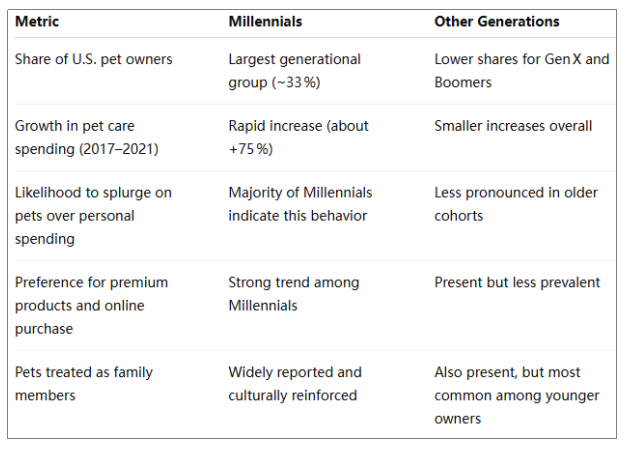
(Table 1- Millennial Pet Spending & Ownership Patterns-U.S.)
Pets provide consistent emotional returns: companionship, stress reduction, and unconditional attachment. These benefits became particularly salient during and after the COVID-19 pandemic, when pet adoption surged and animals became central to coping strategies for isolation and anxiety.
This emotional bond directly influences spending decisions. Studies indicate that a substantial proportion of pet owners are willing to incur debt to cover veterinary expenses or life-saving treatments . In traditional economic models, such behavior might appear irrational. In behavioral terms, however, it reflects the prioritization of emotional value over financial optimization.
In essence, pets occupy a category typically reserved for close human relationships—where cost-benefit analysis becomes secondary to care obligations.
The Rise of the Premium Pet Economy
Millennials are not merely spending more—they are spending differently. Their consumption patterns skew heavily toward premiumization. The pet industry has responded with a proliferation of high-end offerings:
● Organic and human-grade pet food
● Advanced veterinary care, including diagnostics and specialized treatments
● Pet insurance products
● Luxury grooming and boarding services

This shift aligns with broader millennial consumption trends, where spending is concentrated in categories perceived as meaningful or identity-enhancing.
The pet care market itself reflects this transformation. U.S. pet industry expenditure has surged dramatically over the past decade, surpassing $136 billion in recent years . Even amid inflationary pressures and recession concerns, spending on pets has remained resilient, indicating that it is treated as a non-discretionary expense by many households .
In effect, pets have transitioned from a discretionary luxury to a protected budget category.
Social Media and Identity Signaling
Another underappreciated factor is the role of social media in shaping pet-related consumption. Millennials are the first generation to fully integrate digital identity with daily life. Pets frequently become extensions of that identity—featured prominently on platforms like Instagram and TikTok.
Data suggests that a notable percentage of younger pet owners make purchases specifically for social media content, from themed accessories to curated living environments . This phenomenon blurs the line between personal consumption and performative consumption. In this context, spending on pets serves multiple functions:
● Caregiving
● Self-expression
● Social validation
The emergence of “pet influencers” further reinforces this dynamic, transforming pets into both emotional companions and economic assets.

Financial Trade-Offs and Budget Reallocation
One of the most revealing aspects of millennial pet spending is not just how much is spent, but what is sacrificed.
Research indicates that many pet owners actively cut back on personal expenses to accommodate pet-related costs. Nearly 40% report tightening their own budgets to prioritize their pets .
In some cases, this reallocation extends to essential categories. Surveys show that approximately 30% of pet owners spend more on their pets than on their own health and wellness .
This inversion of traditional spending priorities underscores the depth of emotional commitment involved. It also raises important questions about financial resilience and long-term planning—particularly as veterinary costs continue to rise.
The Psychology of Control and Stability
In an era marked by economic volatility, career uncertainty, and social fragmentation, pets offer something increasingly rare: predictability and control.
Unlike many aspects of modern life—housing markets, job stability, healthcare costs—pet ownership provides a domain where individuals can exercise agency.

Spending on pets, therefore, is not just about care; it is about creating a stable, controllable environment. This psychological dimension helps explain why pet-related expenses are often insulated from broader budget cuts.
As millennials age, it remains to be seen whether these spending patterns will persist or evolve. However, current data suggests that the emotional and cultural foundations of this trend are deeply entrenched.
Millennials spend more on their pets than on themselves not because of a single factor, but because of a convergence of forces: economic constraints, shifting life priorities, emotional attachment, and industry evolution.
Pets have become the nexus of companionship, identity, and meaning in a generation navigating unprecedented social and financial complexity.
In this context, spending on pets is not excessive—it is rational within a redefined framework of value, where emotional fulfillment and relational bonds outweigh traditional financial hierarchies.
(This article is intended for informational and editorial purposes only. It does not constitute financial, veterinary, or psychological advice. All statistical references are based on publicly available data and industry reports at the time of writing. Readers are encouraged to consult qualified professionals before making financial or pet care decisions. The author and publisher assume no responsibility for actions taken based on the information presented.)
About the Author
Lena Hartwell is a senior pet industry analyst and lifestyle journalist with over a decade of experience covering consumer behavior, companion animal economics, and digital culture. She has contributed to leading publications in the fields of pet care, behavioral economics, and millennial lifestyle trends. With a background in sociology and market research, Lena specializes in decoding how generational shifts reshape industries—particularly the rapidly evolving global pet economy.
References
[1] Jones, C. (2025). Financial considerations of pet ownership for Gen Z and millennials. Forbes.
[2] Statista. (2025). Pet ownership by generation in the United States.
[3] World Animal Foundation. (2026). Pet spending statistics you need to know.
[4] New York Post. (2026). 3 in 10 pet owners spend more on pets than their own health.
The fun isn’t over—explore more posts and meet more lovable furry friends!